

- This event has passed.
Book Talk : Dashain Special
@ 2:00 PM - 4:00 PM
Free
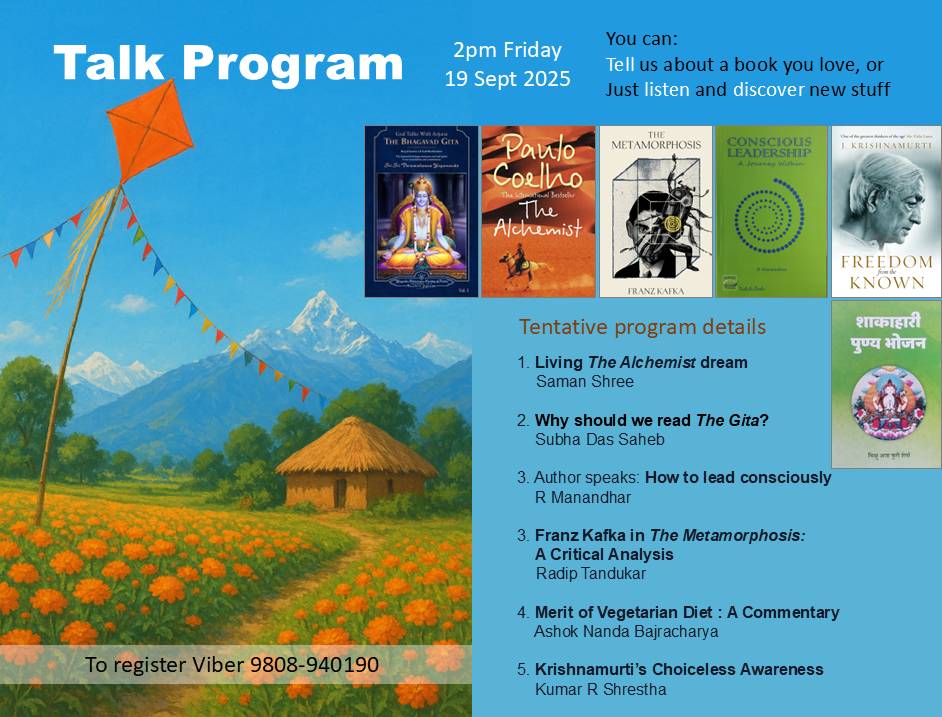
Featured Books / Topics
1. Living The Alchemist dream
Saman Shree
2. How to Lead Consciously?
R Manandhar
3. Franz Kafka in The Metamorphosis: A Critical Analysis
Radip Tandukar
4. Why ‘should We Read the Gita?
Subha Das Sahib
5. Key concepts of J. Krishnamurti’s Philosophy
Kumar R Shrestha
Moderator: Kumar R Shrestha

How to lead Consciously by R. Manandhar
The speaker explained that we are the leaders for ourselves. His book, Conscious Leadership, says we must be conscious first and that we have the capacity for leadership, which he compared to a pearl. When discussing great leaders, one participant mentioned Girija Prasad Koirala, and I said Nelson Mandela as I am motivated by his acts of kindness and his role as a good leader for Africa. His famous quote, “It always seems impossible until it’s done,” always inspires me. One of my friends explained about consciousness.
R. Manandhar further explained that we have to lead by example, which is greater than theory. He used the Mahabharat as an example, an epic with many stories. He noted that Yudhisthir is a great leader, though people often only remember Bhisma, Dronacharya, and Krishna. Yudhisthir always stayed in a low profile and was more focused on righteousness and truthfulness. R. Manandhar also explained about the Kalasutra of Buddhism and mentioned that Mahavir is inclined to philosophy. He concluded by asking why we believe in these things, suggesting it’s because we have heard them many times.
I think R. Manandhar has great potential in training rather than just speaking, as he reminded us from time to time. I wish to attend his training on leadership and to listen to his poems, as he has published some. He disclosed that his book was a collection of his articles from The Himalayan Times, where he wrote as a columnist for more than 10 years. He looked serious, but he made us ask him questions and was very interactive from the beginning until the end of his presentation. This was a great motivation for me: listening more to the audience than explaining yourself.
Why should we read The Gita by Subha Das Saheb
Subha Das Saheb from Kabir Ashram explained the Bhagavad Gita in a way that was both humorous and respectful, which I liked very much. He described the Gita as a song that belongs to everyone; it is not a treasure for Hindus alone. He explained that people interpret the reasons for reading the Gita in different ways, and that true dharma is not found in merely worshipping the book or viewing it only as Hindu scripture. He offered a comforting perspective, saying that if Krishna himself were to read the Gita today, even he would be confused, so it is normal for us to feel confused in this world of overwhelming information. He encouraged us to approach it in a light-hearted manner rather than with excessive seriousness, suggesting that people often have a congested vision and that the text is not the supreme eternity itself. I was stunned when he said, “God is not sleeping while you are sleeping.”
He stated that the Gita is over-glorified and that the common belief that Arjun renounced everything is utterly wrong. He explained that Krishna, through the Gita, taught Arjuna to be a fighter and a warrior. He related this to our internal battles, suggesting that when you feel helpless and entangled in conflicts with neighbors, the real struggle must be confronted within your own mind. He noted that Arjuna ultimately accepted this wisdom smartly and wisely to confront the war, a decision that was beyond one’s imagination.
He mentioned there are 18 chapters in the Gita, presenting a minute analytical study from the perspective of Upasinisadh, and discussed the concept of Karmic bondage, ‘Prarabdh bhog bhumika’. He felt it is the high time and the right time to indulge in its teachings, and that it has a proper utility, especially in the current times. He explained that a Karma Yogi doesn’t focus on how much they work, but rather thinks, “What can I give more than what I get?” He also spoke about there being irreparable mistakes in one’s life.
I wish to listen more about the Gita and his scientific explanations. Throughout his presentation, he maintained a calm and consistent flow. He was humorous and easy-going, unlike other saints or Sadhus, and seemed very practical. Sadly, he left the hall immediately afterwards. Regardless, he seems to me a very great personality from whom we can learn many things about the Gita from different perspectives and improve our lifestyle.
The Metamorphosis by Radip
Radip Tandukar talked about ‘The Metamorphosis’ by Franz Kafka. He discussed Gregor Samsa’s death, noting how the character became immobile and his demeanor shifted from aggressive to defensive after his transformation from a salesperson into a dung beetle. Radip highlighted that Gregor was very caring and tended to his sister, describing the situation as a dual pendulum. He explained that Gregor became very agitated in a surrealistic way and that the story contains themes of toxic masculinity. The central theme explored was a utilitarian one, questioning what we can offer to society; Gregor was the breadwinner, but now he is shamed and made to feel worthless, with his pride existing only for hate. He was alienated from his body and his family, a contrast to his father who was fit and healthy, making the son seem insignificant and living in a shadow. The story triggers thoughts about mental illness and invaluable utilitarianism. Radip gave two books as a takeaway to the audience members who answered his questions and showed curiosity about Kafka. His presentation was smooth, but sometimes it was one-way only; he could have not disclosed the whole story and made it more interactive, though this may have been due to a lack of time.
Krishnamurti’s Choiceless Awareness by Kumar Sir
Kumar Sir spoke about Krishnamurti’s Choiceless Awareness, telling us to explore the inner world rather than the outside world. He further highlighted that he had researched for more than three years to publish his work, which is amazing as these days people publish books easily without much patience, often thinking their autobiography or book is the best and a must-read to change one’s life. However, it really depends, as everyone has different perspectives; some write more about their feelings and sufferings, some do not want to be public, and some are better listeners than bookworms.
He has done an incredible job. He explained that it is very difficult to avoid labeling people good or bad, but doing so brings you peace, as there is always an inner conflict or struggle with no preference due to our totally different conditioning. He said there is no foundation for our choices because they are so momentary, pointing out how many people who like posts on Facebook want others to like them back, highlighting a desperate need for letting it be.
He taught that you have to see things as they are, because when you choose, you become fragmented and divided. He emphasized that we need to embrace mindfulness as it is already embedded, there is no technique, and it is innate. His instruction was to observe as it is and not to react or respond immediately. He advised making decisions that are wholesome and to be careful with objectives; to step back from what seems immediately ‘beautiful’ and tell yourself you will consider it later.
He suggested not to immediately say you agree or disagree and to keep your voice low. We live a validated life where judgment is everywhere, and we have to break free from our conditioning through choiceless awareness. He urged us to move into the unknown area, noting that we are more willing to know the known, and we should stop praising known things and dwell in the unknown. He explained that when you are aware without choice, there is clarity, and clarity brings true action, so we must confront issues to avoid confusion. With this practice, there is less validation, and you find space, allowing you to be fully present. He spoke with a calm flow about mindfulness.
I wanted to ask for clarification, but I couldn’t because there were senior people like Damodar Sir there, and R. Manandhar is also an expert on it, I think, so I kept quiet.
Living the Alchemist by myself, Saman (only summary)
Today, I’m sharing how Paulo Coelho’s The Alchemist became the mirror for my own life. This is the story of a boy from Nepal who searched the world for his treasure, only to find the map that led him back to his own heart.
Like Santiago, I dreamed of distant horizons. My Personal Legend was to travel the world. My journey was shaped by my family—my grandmother, my first alchemist, taught me resilience; my father imprinted on me that “Honesty is the best policy.”
But my path was not easy. School was my first desert, filled with bullying and loneliness. After college, I felt robbed of my direction, a feeling compounded by the tragic loss of a friend. I then entered my “crystal shop” phase—safe jobs that paid the bills but felt like a betrayal of my dream.
Volunteering in Sindhupalchowk became my most important turning point, I met my true alchemists: children living in utter devastation who radiated pure joy. They taught me that true wealth isn’t in possessions, but in connection and purpose.
I finally made it to Europe, my personal pyramids. But I faced betrayal, loneliness, and loss. I returned to Nepal frustrated, thinking my treasure had slipped away.
It was only when I stopped looking outward that I found it. My treasure was never in Europe. It was the resilience I built as a boy. It was the compassion I learned from my mother. It was the honesty my father taught me. My treasure was here, in Nepal, in the person I had become.
Santiago found his treasure under the tree where he started. I found mine by coming home to myself.
Your Personal Legend is calling you. The journey will be difficult, but you must take the first step. Your treasure isn’t at the end of the world; it’s right where you are, waiting for you to see it with new eyes.
Thank you.
Some points:
1. I was given the stage to tell my story, ‘Living the Alchemist Dream’. I did a lot of research, but I still felt I should have done more preparation.
2. Unlike my first program, there were many known faces and adult friends there, including cool musicians from Mantra Muchachos who didn’t know me, though I enjoyed their program at The Art of Living last July.
3. I was a little uncomfortable in the beginning, but I went with the flow, using my review and aligning it to my story.
4. It was totally a one-way presentation, as I thought they would give me interaction time, but I failed to notice that it wasn’t part of the format. However, I did my best.