

- This event has passed.
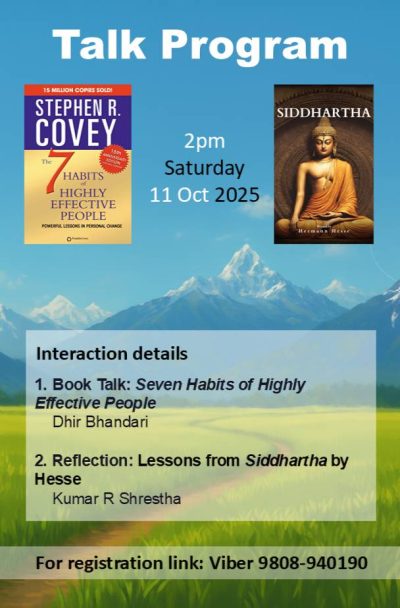
October Book Talk
@ 2:00 PM - 4:30 PM
Free
Program Details
-
- Book Talk: Seven Habits of Highly Effective People
Dhir Bhandari - Reflection: Lessons from Siddhartha by Hesse
Kumar Shrestha
- Book Talk: Seven Habits of Highly Effective People

Dhir Bhandari Sir, a respected person, seemed fully prepared for the presentation on the projector, cool to answer… A trainer who was also active in politics until 2052 seemed more experienced and focused, as he was there and quiet.
He told us about this book, Stephen R. Covey’s The 7 Habits of Highly Effective People. transformed his life; after starting to read it, he quit his government job as he gained clarity about his life. I was stunned to know that, but I also realized how a book can awaken you, how a conversation can make you enlightened, and how introspection can make you feel eternally blessed.
So, I paid more attention, and he highlighted the first chapter where the author talks about you observing your own dead body and what the reaction should be from those coming to take your corpse for cremation. How would you like to be defined by your friends or relatives? How should people define you—as helpful, compassionate, or very stupid, a hell for society? This is indeed a strange but good question for people to change their life or for the process of self-realization.
He showed the drawing of an old woman on one page and again on another. He told us about the paradigm shift and highlighted that the book talks about Learn, Share, and Do. He further added the concept of the ‘Mission Statement’ and that it should be written in just one sentence. Generally, people don’t have a clear goal and just mention things like money for living, a house, and a family.
One should not only think or just say but should write down their goal and also be specific. When there is a big team, it is literally hard to manage.
You should give first priority to the important, not the urgent or immediate work.
In between his presentation, there was a little discussion about why we should not focus on the *pooja* celebrations of others instead of our goal, but Ms. Anju denied that, stating that since we have a web of social connections, we should not deny it. Also, she mentioned this book is written from a Western perspective. However, Dhir Sir highlighted that this kind of activity kills our productive time and we will be left behind in achieving our goals.
You should focus on the activity that aligns with your mission statement. People sacrifice their goals by focusing on children, household chores, and the office. Even on paid leave, people don’t leave their office or home.
You have money, and you earn for money; this is unfair. One can write a mission statement like this, ‘I will get a government job within 5 years.’
Stop making daily schedules, but write a daily journal. You have 15 hours a day, so you can make time for these important things. These days, good things are misused by the community. So, you have to focus on a Private Victory.
He also highlighted the ‘Win-Win’ concept. One should think that if they are going to win, the other person should also win when we work together. We need others to appreciate us.
Truth is always simple, like *amrit* that is tasteless, which is water. All the five elements are like that. We would like to see the world with our eyes, but we have to see from the heart. He explained the Synergy Effect, highlighting it by giving the example of the Marwari community and how they have led the world through donation, demonstrating synergy. Always be new.
Siddhartha by Kumar Shrestha
He was so grateful for his level of understanding and delivery. He clarified that the book *Siddhartha* didn’t win the Nobel Prize, but yes, Hermann Hesse won it for another literature book, and also that this Siddhartha is not Siddhartha Gautam. It is very true that people are confused by its cover or by confused marketing, which appeals to people to buy it or read it somehow.
It was so interesting to participate in his multiple-choice game:
1. Towards the goal or achievement
2. Achieving somewhat and using it
3. Towards high demand of achieving goal and focused
4. For inner peace and self-accomplishment.
I chose option 3, and very few others did too. However, it totally distracted us from the habits discussion to self-realization or a kind of life audit.
Kumar Sir highlighted that love teaches us; he said when there is unconditional love, you will feel freedom. He further highlighted that there is no time and space.
Like in the book, love is sublime, a sublime form of compassion. Govinda teaches Siddhartha a lot, and the boatman does too.
He further added that expectation is the root cause of suffering. There should not be attachment to anything; we should let go.
Give your best to your career. *Con calma*, he always encourages us to read that special book.